Saturday, July 18, 2020

Pandemic Diaries: The Good Ole' Literature Review

Green and leafy London is affording me a nice atmosphere in which to tackle phase one of my UK Master's dissertation. Its working title is "Gift of the Gab: The Rise of the Audiobook and the Festive Turn in Library Science." The scholars I am reading are quite masterful and eloquent and I wonder if I can elevate my chatty banter in time for final publication. Ironically, what draws me to the subject of the audiobook (and to the podcast) is the approachability and egalitarianism of the medium and subsequently, the literature depicting it. Of course, the one community who would be left out is the deaf community; still I do believe the "A-book" reaches quite a large slice of the population who never "caught on" to SSR (Sustained Silent Reading). We've all have had a bad experience or two in high school English class.

So a bit of housecleaning around terminology. A Master's thesis in the U.S. is for an M.A. or M.S. while a dissertation is for a PhD. Here in the UK, it is switched. So do not assume I am more advanced than I am. "When in London, speak as the Londoners do."


After thinking about a topic of research that excites you and discussing it with one's advisor, the working phase one of most dissertation is what we postgraduates call "The Literary Review," basically collecting and collating all that is reputable and relevant to a subject, reading all you can from this collection and taking appropriate notes. One helpful maneuver is to arrange/limit one's own search criteria for the sake of time and relevance. For instance, for the bulk of 80% of my material, I have confined my sources to those academic articles printed in English that are not more than twenty years old (ideally not more than 10 years old!!). Exceptions I have been made for the prominent media and communication theorists of the mid-20th century hailing from "The Toronto School" which is short-hand for "The Toronto School of Communication Theory," a vibrant group and era from the University of Toronto in the 1960s. These include Marshall McLuhan and his protege Walter Ong. Other information behaviourists I am absorbing are the likes of Marcia Bates (famous for the browsing idea of "berry-picking"), Brenda Dervin (famous for "Sense Making"), and Karen Fisher (famous for "Information Grounds"). The latter three American professors have innovative information behaviours that I find close to the audiobook's sense of festivity and egalitarianism. 


The next bucket of researchers in my work shed include current writers and thinkers out of Denmark and London and Cambridge, Massachusetts. The Danish duo, Iben Have and Birgitte Stougaard Pedersen, have written prolifically about sound technology and the audiobook having its moment in educational culture and are doing exceptional work in Aarhus University. Indispensable for his intelligent and approachable style is Matthew Rubery, whose 2016 tome, "The Untold Story of the Talking Book," has been an absolute gem and oasis of knowledge.


The last tier of who and what I'm reading are the trade journal publication articles of librarians themselves. I believe there should always be a vein of practicality in any academic work. My queries include: How much respect do current librarians give the audiobook (personally and vocationally)? Do librarians consider it a worthy rival for the printed book or even the E-book? Are libraries keeping abreast with the surge in demand of A-books, especially during this pandemic and accompanying lockdown? If so, how?

---


The Literature Review is basically the phase in which to devote yourself to devouring the words and works of the leading lights and any other researchers of a certain subject. In my case, it is studying the research regarding sound technology and its effect on library patronage and information gathering. One's first aim as a researcher is to shoot for "generativity," or an ability to contribute something original or noteworthy back into the field and stand tall with one's peers (Terrell, 2016). 


I'm finding with some struggle that a lot of academia is academics "talking" to academics. I would love to be a bridge or at least a "transmitter" between the academic realm and the practical realm. Which is precisely why I enjoy the audiobook and podcast so much - it's not quite straight news or narrative and it's not quite entertainment. But its in-betweenness makes it perfect for this moment of high anxiety and screen fatigue.

More later!

-------

Bibliography

Terrell, S. (2016) Writing a proposal for your dissertation: Guidelines and examples. New York: Guilford Publishers.

Saturday, April 4, 2020

A Deep Dive into the Classics (If Not Now, When?)

I've always preferred the print versions of books to their electronic counterparts. In this age of Coronavirus, especially, it seems we are all overdoing it on the screen time. But with my move to England and my subsequent move back to California, a lot of my books have vanished or have been given away. I use the passive voice on purpose; it feels as if my books make their own decisions of where they end up. Books and natural hippie soaps are the two things I purchase indiscriminately.


So with my paperbacks dispersed, I did what any desperate, self-respecting reader would do in the 21st century: I dusted off my long-neglected Kindle. It was a birthday present from my mom when I had turned 35 (you know, back in the dark ages). I figure that if Shakespeare can pull off penning King Lear in quarantine, surely I can engage with an electronic copy of Little Women. I do want to use this time wisely even if the New York Times is advising the opposite. The quarantine, I publicly vow, will be spent in deep-dive reading all those promising classic novels. At least those which are American, Irish, and British.


Here is my color-coded list of classic novels. 

Red = Cannot stomach.
Orange = Enjoyed as an adolescent; grew out of them.
Yellow = Adored the first time around; will read again.
Green = Actively reading; soon to be devoured.

-----

I'm sorry, Ms. Shelley, but I just can't.

Frankenstein - The first half was decent but the second half was arduous and just not believable. I still think the macabre and the gothic need to have a pinch of believability in order to make them palatable.

-----

The following are novels that I once loved as an adolescent but am having trouble enjoying as an adult.

Brave New World

Catcher in the Rye

Lord of the Flies

One Flew Over the Cuckoo's Nest

-----

Some of my favorite books are below.

The Bell Jar - Beautiful and poetic the first time around.

The Bostonians - James' great satire. Not very PC.

The Call of the Wild - A classic for any dog-lover!!

Confederacy of Dunces - Hilarious first time around; not very PC.

Ethan Frome - I'm already seeing similarities with Wuthering Heights; ill-fated love and gothic feel.

Mrs. Dalloway - I took a class on this; the stream-of-consciousness prose sparkles in a poetic sort of way.

The Picture of Dorian Gray - Another gothic gem.

The Screwtape Letters - Ingenious premise; an epistolary novel between two devils.

Tale of Two Cities - one of my faves. Considered Dickens' most "manly" book; swift-moving and full of action.

-----


Below in green is my active bookshelf.

Wuthering Heights - Fantastic so far. The action and writing grabs you from the start.

The Plague - Beautifully written; had to return my library copy.

Dracula

Little Women

Count of Monte Cristo

Brideshead Revisited

Middlemarch

Vanity Fair

The Mill on the Floss

Les Miserables

Suite Francaise 

If the quarantine lasts and I've exhausted my books in green, there is just one thing left for me to do: tackle the Russians.


Friday, March 20, 2020

French Exit or Unceremonious Departure?

Recently, I was witnessed "ghosting" a house party. A guest in a friend's hallway in East London saw me sheepishly slipping on my red Adidas. "Pulling a French Exit?" he asked. I think the shame of being caught in the act is much worse than the guilt and questioning that plagues you over the following weeks -- "Was it rude or appropriate?". Regardless, a French Exit seems highly misnamed; according to the French etiquette books I've read, the Gauls insist on a long, devoted show of compliments and conversation and a kiss on each cheek to everyone present as they double check their coats for Oyster cards or car keys. The synonym "Irish Goodbye" is one that I can get my head around. The Irish and Irish-Americans don't want to put anyone out or be caught in earnest affection.

Wings near Angel Station

Frankly, it depends on the nature and size of the party.

My own exit from the UK is hasty and necessary and not what I planned. I imagined a lovely, stately graduation ceremony with everyone in tow, my whole British postgraduate family: school friends and professors alike. This was all before the growing menace of the "developing situation" of the Coronavirus pandemic. I figure if I stay any longer in the UK, I may be trapped as more and more draconian (but necessary!) measures are put into place, country by country.

Nice mellow folk band - give it a listen

The UK, I'm sorry to say, has been asleep at the wheel. At one point, the Johnson government was flirting with the idea of "herd immunity". It was uttered on television by health officials on March 13th when cases across the four countries of the UK had reached 798 with a death toll of 11. The idea of "herd immunity" sounded quite dodgy and sloppy even for this non-scientist. Doesn't herd immunity naturally occur when enough people receive vaccination for a disease? And news flash: there is no vaccination for Covid-19. What's more, I believe the Johnson goverment moved far too quickly from their "Contain" phase to the "Delay" phase. In "Contain" there was an emphasis on testing and tracking the contacts of those infected. Last I heard, the Tories have ceased testing even for people who exhibit serious symptoms. In another flip-flop, the UK WILL be testing far greater populations, hoping to bump up a 5,000 a day exercise to 25,000 a day. So maybe there is hope. But as any public health expert knows: interventions have to come early, in a consistent, truthful delivery and with a proactive, muscular approach.

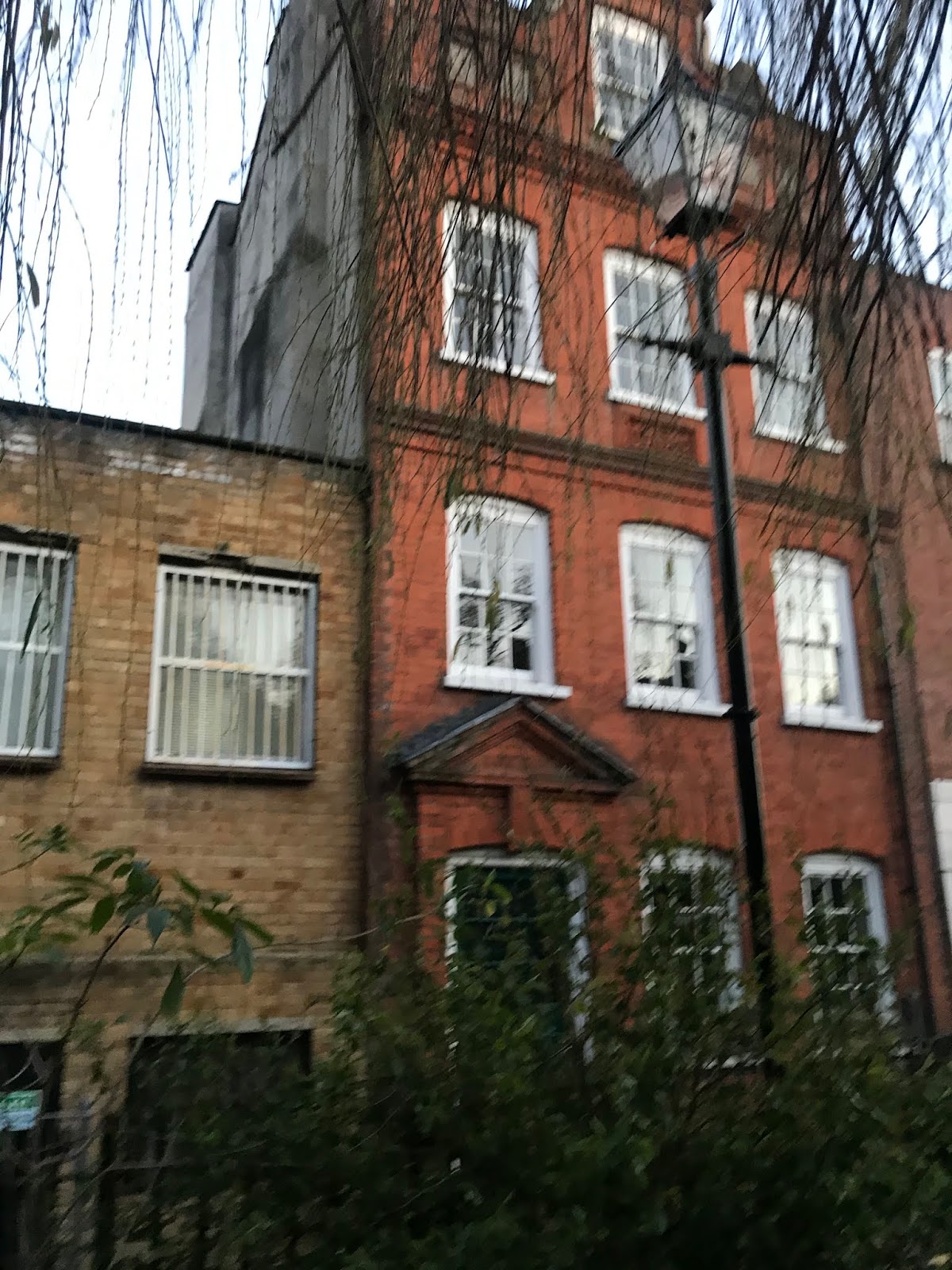
House and Weeping Willow Trees near Essex Road Station

Still, for the greater part of the early crisis, life carried on as usual. There was a "Keep Calm and Carry On" attitude but viruses don't respect stoicism. One factor for transmission rates could depend on the levels of effusiveness and physical affection of a culture. And on this half-baked thesis of mine, England and the rest of the UK may have a cultural upper-hand as they are a people who seem to give eachother a lot personal space. London, though, because of its density is a different animal --which is why it is the epicenter of outbreak in the UK. Maybe why Italy is suffering so is because of their demographics. The CIA Factbook in 2014 pegged Italy as the 5th oldest country in the world. I wonder too if transmission skyrocketed because of the population density as well as the Italians' warm and affectionate mannerisms.

Flowers and another lovely house near Essex Road Station

As for this grain of sand upon a beach, I've decided to return to California pronto - out of concern for my partner and my family and the possibility that I may be trapped in the UK for up to 18 months if I resort to inaction. Borders are closing all over the world and it's easy to see the airlines discontinuing international flights. I did hear one happy rumour that United Airlines is the leader in making sure American citizens get home safely (they probably won some sort of contract on that end). Let's just hope I make it in time, for United was the airline I chose.

Major Arcana - Card #9 The Hermit, represents Virgo, Secret Knowledge and Introversion

Emotionally, I feel calm and focused but the whole fly-by-night departure just feels so unceremonious. My postgraduate instruction has moved on-line and there are other international students returning early to places like Singapore, Eastern Europe, Chile and the Caribbean. Not much of a peep from the other five American students. We are all encouraged to finish our coursework in a virtual format and I'm hoping I can communicate with my dissertation advisor by Zoom, FaceTime or Skype.

I thought this display was clever. Possibly Finsbury Library in Islington borough?

City Library books: Reference Guides, Sermons on Equality, and Glimpses into the Future

Two books for my class "Libraries and Publishing": Blog Theory and Alone Together


 Did I tell you that I want to be a librarian when I grow up?


Not to make it all about me but my karma of pulling dozens of French Exits throughout my life has come to bite me in the behind. Ceremony and conversation and hugs and good-byes are so important especially when the wolf is at the door.

I'll have a fuller, more poetic, review of my time spent in London in a later post.

Thursday, January 30, 2020

Rembrandt and the Museum of Brands

When you think of New York, what comes to mind? Perhaps the ubiquitous logo adorning the world's t-shirts: 


The graphic designer, Milton Glaser, came up with the logo idea while riding in the back of a taxi in 1976.

How about Texas? Do you know they had a PR and PSA coup with their intimidating warning: "Don't Mess with Texas." That slogan, created by the Texas Department of Transportation, not only gave Texas a bit of chutzpah on the national stage but it urged the state's litterbugs to rethink their habits. Studies found that the campaign helped reduce litter by 72% on Texas highways over a three-year-period. The warning soon took on a life of its own; it's basically become the state's unofficial motto. It soon became a rallying cry for the Texan people's grit and bravado.


While there is usually some type of strategic intent behind branding, there are some cities or states that fall into branding by accident. Boston, for instance, was long known for its sports teams, peculiar Irish inheritance, and density of colleges and universities. That all changed with Bostploitation and the spate of films based on the crime suspense novels of Dennis Lehane. (Not only did I meet him once in 1999 when I was working at the Braintree Barnes & Noble's but my godmother, Tricia, took a creative writing class with him.) Gone Baby Gone and Mystic River were two of his novels adapted into popular films. Other films in the Bostploitation genre include the seminal Good Will Hunting and The Town. These films made it seem like Boston was a thieving scoundrel with a heart of gold. With Bostploitation, you see a scene of some Irish mafia character summoning the Virgin Mary before robbing a bank. The only value worth having in these movies is loyalty. But as New Hampshire boy, Seth Myers, knows too well, it's often the sound of the locals that can give a city its identity.


https://www.youtube.com/watch?v=rLwbzGyC6t4

This type of tough boy image hasn't put a dent in Boston's international image. In fact, out of the six New England states, Massachusetts has had the highest population growth in the past ten years at a 5.4% increase, far outpacing the other five states in the region. For me, it's still home. You could say that everywhere is unique but Massachusetts is truly unique.


There are some places that shouldn't even try with even the idea of branding. South Dakota ran amok with their "Meth: We're on it" PSA campaign. While this was meant as a way to encourage South Dakotans to think about their community's ills, it quickly became a horrid and ill-conceived branding idea and an internet meme that sent social media aflutter.

-------

London has never had a problem with branding as it happily sits at the center of the universe. I never hear Londoners bemoan that their city is not like New York. I do however see a fascination, envy, and curiosity amongst my British friends over all things American. California, especially, puts a spell on the Brits that I've spoken with. 


Fruit & Veg Garden @ Kilburn Station Platform
Jubilee Line


The beauty of London's branding is color-based: blood red against a charcoal beige background with a mix of rainy Monday grey. All of its seminal images have that shade of pure blood red: the telephone booths, the double-decker buses and the famous royal guards. For neutrals, you can find your stately grey Tower Bridge replicas and the neutral Gothic edifices holding Big Ben and the UK's Parliament. 


"Byng Place" by Dun.can is licensed under CC BY 2.0 cc-iconby license icon

So while Londinium has long had a certain palette and aesthetic, it was never a believer in brands. London does, however, have a whole museum devoted to brands: the exhibition, study and criticism of branding. In West London is the Museum of Brands, a place where all forms of ephemera is on display in the "time tunnel" - everything from Victorian cigarette boxes to boy-band One Direction lunchboxes circa 2010. Taking photos of the items is strictly prohibited but I did manage to capture a poetic photo of the exterior. The main exhibition is the life's work of museum founder, Robert Opie; over twelve thousand items splendidly curated.


At first, to be honest, I was a bit skeptical of branding, seeing as how it has such a powerful link with fascist history. But, Mauricio, in so many words, encouraged me to look at branding in a more agnostic way. For everything we do and everything we are has an element of branding. It's a part of capitalist culture. I'm much more geared towards text and literature but the interesting thing about the Museum of Brands is they take a progressive, critical eye towards the idea of branding. Several times a month they hold workshops, lectures and exhibitions for school groups, families and trade groups. One coming up in July, for interested adults, is entitled Is Your Brand Queer Enough?


Robert Opie's twelve thousand items is not the only display in town, however. A much smaller, more intimate collection can be seen through February 2nd at a village venue south of the Thames, the Dulwich Picture Gallery. "Rembrandt's Light" was a fantastic Saturday day-trip exhibition. Branding existed in Rembrandt's heyday (Holland in the 17th century), but it had likely more to do with flags and royal colours and coats of arms. Rembrandt's use of light in his painting technique was not a brand or even a signature but something more substantial: the theme or central narrative of each of his paintings, all of which seemed to tell a story from the New Testament. 


Most people would not peg me as a churchgoer and although I celebrate my pagan roots, I cannot escape my Catholic upbringing, at times I embrace it. In the permanent main gallery, there is even a famous painting of my "confirmation" name saint, Sebastian, in all his suffering.


Rembrandt brings me closer to my dormant faith as do Christian-Secular-Crossover artists like Al Green and Lauryn Hill, even the openly-Catholic, witty comedian, Stephen Colbert. Religious or not, there is only a few days left to see the Rembrandt's exhibition before it closes on the 2nd of February. You can then find out for yourself not only if Rembrandt had a brand in mind or if he was driven by something deeper.

As for London, its brand can't be condensed into a pithy slogan - although there are a slew of quotes that try to do it justice. I feel that in living here, the whole world is just a tube ride away. It can rely on the strength of its resources and its centuries of innovation.

------
References

https://en.wikipedia.org/wiki/I_Love_New_York

https://en.wikipedia.org/wiki/Don%27t_Mess_with_Texas


https://en.wikipedia.org/wiki/Dennis_Lehane

https://www.brookings.edu/research/population-change-and-the-projected-change-in-congressional-representation/

https://www.theguardian.com/us-news/2019/nov/18/south-dakota-meth-were-on-it-addiction-campaign

https://en.wikipedia.org/wiki/Londinium

https://www.museumofbrands.com/

https://www.dulwichpicturegallery.org.uk/whats-on/exhibitions/2019/october/rembrandts-light/

Tuesday, December 3, 2019

Controversy at the BL Symposium on Decorum and the Soul of the Humanities. DITA Assignment #3

Tuesday, December 3, 2019


Gosh, where do we start with this one?

                                                                                                                                     Photograph: Alamy                 

Our class had taken a field trip to the British Library Digital Labs Symposium which ended up being like an awards show for the most cutting-edge projects associated with local research groups. There was free food, an explicit call to "network" (a term that gives me the willies when spoken aloud), and a number of creative projects.


The keynote speaker who kicked things off at the ripe hour of 10 a.m. was problematic in several different ways. Armand Leroi's talk entitled "The Science of Culture" basically used a number of infometric ways of tracking what lyrics and chords and instruments had been used in American Top 40 charts since 1960. While initially quite intriguing and entertaining, one ended up asking after all his graphs and boasts: "What is the point of culture if it can be so distilled?"

PRESENTATION

At any event, it is always important to know your crowd and Armand Leroi, Professor of Evolutionary Biology at Imperial College, came up blind and deaf in this regard. Leroi is no stranger to controversy. He enraged Beatles fans by dismissing their music as "ditties for prepubescent girls" -- at one point all of Liverpool wanted his head on a stick. He claimed he had the charts to support their non-innovation. 


As for the British Library Symposium, Leroi's first one or two bawdy, edgy jokes about sex and music had at first produced a few chuckles but when he kept continuing, you could see many of the women and several men grow a bit uncomfortable. At one point, he launched into a full examination of how Robin Thicke's and Pharrell Williams's 2013 hit song "Blurred Lines" was accused by the estate holders of Marvin Gaye of copyright infringement. The accusation was that Thicke and Pharrell lifted the style, chord and drumming progression of Gaye's "Got to Give it Up." A lawsuit ensued (ahem) and Gaye's estate proved victorious. Leroi was surprised that Gaye's legal team had won and had called Thicke's number, "a good song by the way." So while he went into a detailed tirade of the legal implications of "Blurred Lines," he did not utter one word of the huge number of controversies around the misogyny of the song, the video, and its celebration of date rape culture. The outrage of the song's popularity, at least in the US, was an enormous story that dragged on for weeks. Evidence can be found here in the HuffPost, in the UK's Telegraph, and in The Daily Beast.


                                                           Credit: 7000 in Solidarity

Beyond that there were more penis jokes in the presentation than there were about the musical contributions of women, even pop stars like Whitney Houston, Aretha Franklin, Lauryn Hill, Madonna, Pat Benatar, or The Go-Go's. While Leroi went through pains to emphasize how hip-hop in the 1990s is where we (as in the listeners of Top 40 charts in the US and UK) saw true musical diversity and divergence, he did nothing to look at other forms of music like punk, disco, reggae, alternative/grunge rock or electronica. 

CONTENT

My feeling I guess is why just stop at instrumental composition if one is going to use the full weight of data analysis to judge at which points music became more diverse? (Leroi claims that the 1980s were a flat point because of the droll drum machine background of Disco and New Wave!) Of course, Hip-Hop was a laudable new form of music and cultural expression that picked up steam by making it on the charts of the 1990s with stars like N.W.A., Public Enemy, and Tupac Shakur (I do love me some Tupac!). And maybe this was part of Leroi's purpose: to look at the early 90s as a time when African-American R&B and Hip-Hop artists finally "made it" by becoming successful and breaking into the Top 40. But why stop at sound composition? What about looking at record labels (were there any indie labels that were breaking into the top 40)? How about gender and sexual makeup of bands and groups? Provenance (which cities were put on the map - for instance, Seattle, definitely, by 1992)? If Leroi really wants to do something to win over his critics, he could launch more of a musical/bibliographic exploration of how unknown African-American bands had FIRST came up with new forms of music before moneyed, white groups appropriated the music and brought it to the masses on the Top 40 (which Leroi used as a platform for most of his research). 

                                                                                                                             Courtesy of FX

I'm afraid his lecture encapsulated why so many liberal arts and humanities majors like me are up against a cold, infometric 21st century that is giving us the heebie-jeebies. Human beings are still human beings no matter how much are actions are measured and manipulated. There is a richness to our emotional lives and our backstories and our trials and tribulations. You can't strip the music from the story. You can't divorce the writer from the novel. What is the point of the humanities if it is going to be distilled into its elemental existence? What is the point of living? In high school, many insecure young people find their "voice" in chorus or in a an English or creative writing class. Many young people learn about harmony and confidence and cooperation while playing in the school band. To not take these factors into account is to deny our humanity. There's going to be a big backlash soon if it hasn't already started.


REFLECTIONS

I'm of two minds when it comes to pastiche or the celebration or imitation of another's work, life, or art in a light-hearted but generally respectful way. When DJ Dimitri from Paris with his lounge/bossa nova track, Une Very Stylish Fille, lifted several quotes from my one of my favorite films, Breakfast at Tiffany's, I find it hilarious and charming. In fact, pastiche and remixing is what rave and hip-hop culture was all about in the 90s. When Madonna went full tilt and launched her hit song and video VOGUE in 1990, people were thrilled. I was eleven at the time but as I had come to know myself as a gay teenager I understood that VOGUE had a connection to the ballroom scene of New York in the 80s where so many black and latino GLBT kids had been kicked out of their family homes and found refuge in "houses," and in music, dance, competition, and community. For me, this communal knowledge came in the form of a recommendation of a  documentary called Paris is Burning which had also been released the same year as VOGUE. Did Madonna give enough "props" to the drag ball scene of New York in her super-hit? Was there enough cultural conversation, enough credit where credit is due? I'm sure there is still a lot of discussion about credit and shine amongst the drag ball community.

                                                                                                                              Courtesy of FX

For fun, I have been watching POSE on BBCiPLayer and have come to know this community in an even deeper and more intimate way. While a tad saccharine at times, I was deeply moved and entertained, especially over the course of Season 2. Obviously, my life in white suburban Boston as a youngster in the 90s was a far cry from the drag ball scene of a multi-colored New York in the 80s. All we shared was a sexuality, an outsiderness in some ways. But our experiences were vastly different. Creativity and community is SO important when one is faced with disadvantages. I'm not claiming to be a social justice warrior but I do want to make sure I retain a sensitivity and a cultural curiosity of where artistic movements come from. I'm hoping Armand Leroi can give his subjects the same generosity.

                                                                                                                           Courtesy of FX

Wednesday, October 30, 2019

The Raven Has Landed: What do Edgar Allen Poe and Glenn Close know about Linked Open Data?

The raven has landed! And just in time for Halloween.


                 "The Raven" by Ivan Misic is licensed under CC BY-NC-ND 4.0 via Creative Commons

Let me explain.

In our course at City, University London, we are exploring the phenomenon of creating a shared language on the web that computers can understand and speak. The idea is called Linked Open Data (LOD) and it is a component of what advocates call "The Semantic Web" (Floridi, for one, takes umbrage with this term and instead refers to it as the "Meta-Syntatic Web")(Floridi, 2009). One of the biggest advocates for establishing Linked-Open-Data is none other than Tim Berners-Lee, an English inventor who currently lives in Boston, Massachusetts, and the fellow who brought us the world wide web in the early 90s. In a much heralded 2009 TED talk, Berners-Lee explained some of the concepts of Linked Open Data (LOD). At one point, he even summoned his audience to scream out "Raw Data Now!"


                                                                Ted Talk Video, The Next Web, Ted2009

It was the battle cry of nerds everywhere.

To his credit though, LOD has the possibility of nudging the economy and scientific/aesthetic/humanitarian spheres into overdrive - that's because instead of data exchange having to rely on human-to-human contact on the web via HTML (think of all those hyperlinks you see in webpages and documents), the new method would be computer-generated automatic links that do the heavy lifting for us. 

As it stands now, much of the web's data is still couched in proprietary terms and trapped within the information silos of the earliest Web 2.0 pioneers like Facebook, Apple, LinkedIn, Instagram and Twitter. These behemoths, unsurprisingly, are slow to get on board and share their data (Amazon is actually one notable exception and has been opening it up its data through its Amazon Web Services). With the other big players, we are left with the dusty tools of HTML and HTTP, relying on human beings to make the connections and not computers.

Glenn Close and Easter?


                                                                     photo by Alan Light

You may have noticed since 2012 that Google (another big player that is making strides in opening up data) created their "Google Knowledge Graph," an informative panel of the right-hand side of the page accompanying popular searches; it reads much like a Wikipedia entry. This creation is in line with linked open data; it is a graph mostly generated by computers rather than by human efforts.

For linked-open-data to work, it requires a triple:

OBJECT -------- PREDICATE -------- SUBJECT

The Predicate, or relationship, is the most important part.

Let us first go to "The Raven" example:

The following slides with the black background are from an excellent video by OCLC, the non-profit Online Computer Library Center, entitled "Linked Data for Libraries."


                     Photo Credit: Thomas Kilduff, Slide of OCLC's Linked Data for Libraries Video


                     Photo Credit: Thomas Kilduff, Slide of OCLC's Linked Data for Libraries Video


In linked-open-data, it is important to remember that one of the prerequisites is that each person, item, or concept has a URI (Uniform Resource Identifier). This is distinct from the more familiar URL (Uniform Resource Locator). Think of a URI similar to a book's ISBN, the 13-digit International Standard Book Number that is unique to each book in print. Thus, "The Raven," by Edgar Allen Poe, has a different URI than the common, squawking, blackbird "raven" (although each are equally spooky). The LOD programming schemes are able to disambiguate between them. With a separate URI, linked-open-data initiatives do not have to think closely about context (OCLC, 2012).


                     Photo Credit: Thomas Kilduff, Slide of OCLC's Linked Data for Libraries Video

So just for fun, I wondered if for experiment's sake I could see if linked-open-data would find a connection between Glenn Close and Easter, a sort of parlor game of "Two Degrees of Separation." If Glenn Close had played an unstable femme fatale in the 1987 hit thriller "Fatal Attraction" and her character had done something unspeakable to a pet bunny rabbit, would she be connected to the Christian holiday of Easter since that is popularly represented (at least in the U.S.) by the famous Easter Bunny? 


                                         Photo Credit: Thomas Kilduff, Still of Google search "Glenn Close Bunny"


                                      Photo Credit: Thomas Kilduff, Still of Duck-Duck-Go search "Glenn Close Bunny"


Here you see that Google includes a Knowledge Graph when the search items of "Glenn Close and bunny" are paired but Duck-Duck-Go does not (although Duck-Duck-Go does include a knowledge graph when "Glenn Close" is searched alone). Neither  search engine provides a Knowledge Graph with the exotic pairing of "Glenn Close and Easter." Coincidentally, it looks like Glenn Close (whom I adore for the record) wore a periwinkle, tin foil-like dress to a premiere in Australia last April, so a critic from the Sydney Morning Herald wondered if it heralded a trend (Singer, 2019).


                            Photo Credit: Thomas Kilduff, Google Search "Glenn Close Easter"


                                                     Photo Credit: Jordan Strauss, AP

So why is all of this important?

Many hardworking individuals and organizations have been making LOD a reality at places called Schema.org and the VIAF (Virtual International Authority File). Librarians, especially, have been on the front lines as we specialize in taxonomies and ontologies. In fact, libraries of all kinds (medical, public, academic, legal) are already using linked data in order for our institutions to operate. 

Beyond that, the principle is about treating the internet and the world wide web as a shared resource, a utility rather than as a capitalist playground. Cooperation would flourish and those who want to cordon off their proprietary data would be banished from the marketplace and the conversation.

Personal Reservations

The idea of LOD is full of earnestness and idealism and is one in which hardworking individuals work across borders and languages. Participants include the national libraries of some three dozen different countries in places as diverse as New Zealand, Chile, Iceland, Lebanon, and Singapore (VIAF). If we can do that with coding languages, think of how we can share brainpower on other big-ticket agenda items like tackling inequality, poverty, disease, and climate change. 

But it must be said: Are we giving the VIAF too much power as a centralising force? Are triples subject to hacking and grafitti? What if a spurned ex-lover was somehow able to hack into the system and claim that YOU (Subject) ----- ROBBED (predicate) ---- BANKS (OBJECT). Would that action be tedious if not impossible to clean up?

Additionally, is there a place for humour and irreverence, and poetry (excepting Poe) in the world of linked data? Would our on-line society become too literal? Would it become a place of less creativity and become a breeding ground for what JK Rowling calls "Muggles?"

And if everything is limited by the predicate (or relationship) within the triple, does this limit the dynamism of the human experience? Like Walt Whitman once said, "I contain multitudes." Were he alive today, would he find LOD too stifling?

------


Resources

Floridi, L. (2009) 'Web 2.0 vs. the Semantic Web: A Philosophical Assessment' Episteme. Available at: https://uhra.herts.ac.uk/handle/2299/3629 (Accessed: 30 October 2019).

OCLC (2012) Linked Data for Libraries [YouTube Video]. Available at https://www.youtube.com/watch?v=fWfEYcnk8Z8 (Accessed: 30 October 2019).

VIAF: Virtual International Authority File. Available at https://www.viaf.org/ (Accessed: 30 October 2019)

Links (Chronologically) 

City, University London https://www.city.ac.uk/study/courses/postgraduate/library-science
Linked Open Data (LOD) https://www.w3.org/standards/
Tim Berners-Lee https://internethalloffame.org/inductees/tim-berners-lee
2009 Ted talk https://www.ted.com/talks/tim_berners_lee_on_the_next_web
HTML https://html.com/
Information Silo https://en.wikipedia.org/wiki/Information_silo